Sunday, January 22, 2006

Back from the abyss

Appearances to the contrary, I have not abandoned this blog. It's just that very little happens in the Aust Lit world over the Christmas/New Year break. But it's time to start sorting out one's working life v. one's Arts Festival program on a detailed daily basis (I have already made one bad double-booked blue here) and that means getting organised for Adelaide Writers' Week.

The Australian names I have ticked on the program as absolute must-sees include Robert Drewe, Delia Falconer, Helen Garner and Gail Jones, all of whom are Not From Here (which means I rarely get to see or hear them), and are not only exceptional writers but can be absolutely 100% counted on in any given public forum to have prepared carefully, to engage fully with whatever panel they're on and whoever is interviewing them, and to be interesting and civil no matter how brutal the hecklers or the weather.

Gail Jones has a new novel, Dreams of Speaking, that I think is even better than Sixty Lights. It's due out in February, so it will be particularly interesting to hear her talk about -- and, one hopes, read from -- that.

My deplorably predictable picks of the OS guests include Margaret Drabble, Val McDermid, Vikram Seth, Minette Walters and Simon Winchester, but that says more about my patchy knowledge than it does about the others on the list. What's happened at every writers' festival I've ever been to is that some totally unexpected star emerges and charms everybody. In 2000 it was US writer and academic Michael Ignatieff, now in politics, about whom there was a huge buzz by the end of the week.

I'm about two-thirds of the way through Minette Walters' Devil's Feather and it's reminding me why I stopped reading her stuff: while brilliant, it is too deeply creepy and weird to read for unadulterated pleasure. I managed to finished American Psycho -- yay me -- so can claim a reasonably strong stomach, but Walters is a much more sophisticated manipulator than Easton Ellis of narrative pace and of psychological extremes. Too often her message, or one of her messages, is that there is simply no place to hide, and this just is not something that I wish to know.

Often the first week of March in Adelaide is summer's last gasp, and since Writers' Week is still held at an outside venue, it can get pretty brutal. But it's never as bad as what usually happens at the Melbourne Writers' Festival*, with the August ice and sleet pelting down outside the Malthouse and five thousand people huddling in the indoor space, shouting at each other in order to be heard, pushing each other out of the way in the staircase queues and stinking of wet wool. True, the Adelaide punters tend to smell of wine and sweat by the end of a brutal day -- but at least we're outside.

*Note position of apostrophe. Robert Dessaix was once seen to look up from a program on which was written 'Melbourne Writer's Festival' and inquire gently 'Who is this lucky writer?'
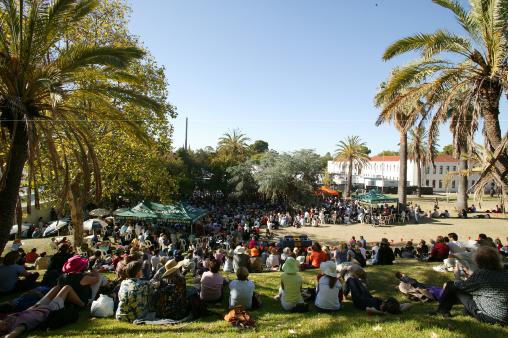

Image from here, where there's also a full list of guests.

Friday, December 23, 2005

Three Aust things to read for Christmas

1) The current Bulletin, which has chapters from a new novel by Murray Bail, a riveting essay on religion by Christos Tsiolkas, Eva Sallis on foxes in Tasmania, Kate Grenville on being an Australian in an English library (always a horrible experience; if I ever have to do that again I will bung on a cut-glass accent like the Queen's), the multi-talented William McInnes on cricket, the ever-classy Gideon Haigh on Enron, four calling birds, three French hens, two turtle doves and a classic Patrick Cook: 'The artist formally [sic: is this a joke or a typo?] known as Mark Latham will launch his next book, You've Got to Have Friends, in time for the Christmas rush out of the shops. He'll finally have time for his favourite sport, speedway racing, in which he will have a dizzying array of cars to chase, barking.'

2) Marjorie Barnard and Flora Eldershaw's story 'Christmas' (1931), a lovely, wry comedy of manners about assorted punters left behind in the raw new capital at Christmastime.

3) Olga Masters' 'The Christmas Parcel'. If I had to name the great Australian short story of the 20th century, this would probably be it. Seriously.

Thursday, December 8, 2005

Snapshot

Michael Davie, editor of The Age from 1979 to 1981, died in England last night after a long illness. Here from crikey.com.au is co-proprietor and former McPhee Gribble publisher Diana Gribble's account of how she learned of his death: "Helen Garner, who rang with the sad news from Oxford, says she made a spectacle of herself by sobbing in a public telephone booth when she heard it."

Rhythms of the mind

Driving home this afternoon, I caught a bit of Ramona Koval's interview on Radio National with WA poet Fay Zwicky, who's this year's winner of the Patrick White award. What an old poppet he must have at least partly been to think of such a thing: this prize is for writers of mature years who haven't received as much recognition as they deserve.

Zwicky was talking about what a poet is and what a poem is, and used a wonderful phrase: 'rhythms of the mind'.

I was reminded of something Vincent Buckley said to me about twenty years ago in the Melbourne University English Department tea-room, when he too used the word 'rhythm' to describe the way he thought poets or any kind of artists needed to arrange their time; artists, he said, need big chunks of time in which to do nothing much apart from mooch and moon about. (The context of this conversation was how bad he thought the academic life was for writers.) There go the chances of every woman writer on the planet then, I thought but opted not to say.

Zwicky's observation was about something quite different: the way we think in words and images, and the way we fit them together. What was interesting was the notion that two such different poets, talking about different things twenty years apart, should have both have chosen as a metaphor a quality so central to their common practice.

Monday, December 5, 2005

What is criticism?

Essayist, fiction writer, memoirist and critic Gerard Windsor was last week awarded the annual Pascall Prize for critic of the year.

Windsor was travelling in Spain when told by email that he'd won this year's award and says he was glad it wasn't a surprise on the night, as the warning gave him the chance to prepare a coherent thank-you speech. SMH journalist Catherine Keenan in her December 1 piece on the award calls him a 'polarising figure' but doesn't say of whom.

The prize is the legacy of Sydney journalist Geraldine Pascall, who died of a stroke in 1983 at the age of 38; the inaugural winner was Marion Halligan in 1990. Other winners have included Roger Covell and Andrew Ford for music criticism, John McCallum for theatre and Noel Purdon and Julie Rigg for film. Last year's winner was literary critic Peter Craven, himself a more contentious figure in Australian literary circles than many of the objects of his critique.

The Pascall Prize is judged each year by a panel consisting predominantly of previous winners. It aims each year to identify and reward a critic whose work is itself creative, has 'the capacity to excite new interest' in a particular subject and which '‘helps Australians experience aspects of their culture with greater knowledge and perception'’. If they win the prize, says trustee Adrian Read, 'it will be for the writing itself.'

Driving home tonight from the Adelaide Critics' Circle Awards ceremony -- these are for theatre -- I serendipitously caught on Radio National a live recording of a panel of theatre people, Helen Thomson, Lee Christofis and Alison Croggon among them, discussing the difference between criticism and reviewing. Most hard-core literary types don't have any trouble making this distinction but it was interesting to hear theatre and dance critics try to thrash it out, as the differences when trying to write to a tight deadline about a live performance are, well, different.

Poet, critic and blogger Alison Croggon made the excellent point that theatre reviewing is usually straight journalism -- a brief description of an event, written to a tight deadline -- where 'criticism' is a more leisurely, reflective and discursive activity that puts theatre in the context of the wider culture.

Sunday, December 4, 2005

Putting the money where the meme is

After giving the matter due consideration, here are my own responses to the Aust Lit reading meme (see Nov. 14 post):

1) Which Australian poem are you most confident you could recite from memory?

Gwen Harwood's 'Suburban Sonnet' -- only because Robyn Archer set it to music and I used to have the album ('Wild Girl in the Heart', title taken from a Dorothy Hewett poem). We're talking vinyl here.

2) Which of the Seven Little Australians are you?

Bunty. No question.

3) Which is your favourite Patrick White novel?

The Eye of the Storm.

4) Which is the best Patrick White novel?

Gah. Um -- A Fringe of Leaves or The Tree of Man, I think.

5) Which Australian fictional/dramatic/poetic character do you fancy most?

There's a sailor in a Dorothy Hewett poem called 'Go Down Red Roses' that I always rather liked the sound of.

6) And which do you identify with most?

Shannon in Ride On Stranger.

7) If you had to read five Australian poems to a heterogeneous unknown audience, which five would you choose?

JS Neilsen's 'The Orange Tree', Gig Ryan's 'If I Had a Gun', all of 'Five Bells', all of 'The Buladelah-Taree Holiday Song Cycle', and all of Judith Wright's 'The Shadow of Fire: Ghazals' ('There's altogether too much I know nothing about.').

And I'd allow breaks for meals.

8) Which five Australian books would you take to a desert island?

Voss, Come In Spinner, Carmel Bird's Penguin Century of Australian Stories, David Marr's bio of P White, Nadia Wheatley's ditto of Charmian Clift. This is about memory -- these are the books that would elicit the greatest breadth, depth and variety of memories to contemplate as I sat on the beach getting skin cancer.

9) If you were a guest at Don’s Party, would you be
(a) naked in the pool
(b) upstairs having sex
(c) outside having sex
(d) sulking with a headache
(e) huddled round the TV
(f) crying
(g) more than one of the above (please specify)
(h) other (please specify)


(g) -- huddled round the TV, crying.

10) Tim Winton or Christos Tsiolkas?

Gotta be Christos.

11) Banjo Paterson or Henry Lawson?

Gotta be Henry.

12) Henry Lawson or Barbara Baynton?

Gotta be Barbara. The blacker of two options, every time.

13) Was Helen Demidenko guilty, and if so of what?

Failure to control narrative point of view; bad hair behaviour.

14) What’s the worst thing you’ve ever seen at a writers’ festival?

Edmund White saying to a fellow-panelist as they climbed onto the stage to do their thing: 'What is it that we're supposed to be talking about?'

Friday, December 2, 2005

Gelder and Salzman regroup

Ken Gelder and Paul Salzman have begun work on a follow-up study to their book on contemporary Australian fiction, The New Diversity: Australian Fiction 1970-1988. It's planned that the new book will bring the study up to date.

The mind boggles at the notion that it's been another 18 years since then. It'll be interesting to see which fiction writers from the 1970s and 80s have gone on thriving through the 1990s and into the new century; Kate Grenville is one name that leaps to mind.

I wonder if they'll want to call it The New New Diversity -- and, if so, whether any publisher would let them.