'How do you make your money, Tib?' Miss Slattery asked, picking at the mink coverlet.
'I am Hoongahrian,' he said. 'It come to me over ze telephown.'
Presently Szabo Tibor announced he was on his way to inspect several properties he owned around the city.
He had given her a key, at least, so that she might come and go.
'And have you had keys cut,' she asked, 'for all these other women, for Monday, Tuesday, Wednesday and Friday, in all these other flats?'
How he laughed.
'At least a real Witz! An Australian Witz!' he said on going.
It seemed no time before he returned.
'Faht,' he said, 'you are still here?'
'I am the passive type,' she replied.
Indeed, she was so passive she had practically set in her own flesh beneath that glass conscience of a ceiling. Although a mild evening was ready to soothe, she shivered for her more than nakedness. When she stuck her head out of the window, there were the rhinestones of Sydney glittering on the neck of darkness. But it was a splendour she saw could only dissolve.
'You Austrahlian girls,' observed Tibby Szabo, 'ven you are not all gickle, you are all cry.'
'Yes,' she said. 'I know,' she said, 'it makes things difficult. To be Australian.'
-- 'Miss Slattery and her Demon Lover', The Burnt Ones, 1964
Thursday, August 10, 2006


Tuesday, August 8, 2006
Get your oven-fresh Aust Lit news here
Australian Book Review now, as of yesterday, has a blog!
And from it, I have learned that First Tuesday Book Club has decided to replace one of their two projected books for next month's discussion, Helen Garner's The First Stone, with something else.
On the whole, I think this is just as well, as I think it would have dominated discussion to the point of obliterating comment on any other aspect of the program. Blogospheric discussion of the first episode over the last week has inevitably centred on Garner and TFS, and I am still as astonished as I was when it was first published in 1995 to see the bile still being poured over Garner by people who are still proud to say they have not actually read the book.
Many of these are people who would rightly scorn to write 'I know this is true, because my friend told me' in a scholarly footnote, so why they think it is okay to argue this way elsewhere is one of the mysteries of life.
No matter what one's position, it is intellectually indefensible to trash a book that one has not read.
Monday, August 7, 2006
Things I would have blogged about here by now if I'd had the chance
1) Kate Grenville reading and talking about The Secret River at the University of Adelaide the Friday before last
2) The ABC's First Tuesday Book Club
3) John Kinsella's wonderful gossipy memoir, Fast, Loose Beginnings: a memoir of intoxications
4) More Patrick White
It won't heppen overnight. But it wull heppen.*
* Ancient Rachel Hunter joke
2) The ABC's First Tuesday Book Club
3) John Kinsella's wonderful gossipy memoir, Fast, Loose Beginnings: a memoir of intoxications
4) More Patrick White
It won't heppen overnight. But it wull heppen.*
* Ancient Rachel Hunter joke
Tuesday, July 18, 2006
The Gospel According to St Patrick
Laura has a new post over at Sarsaparilla making the excellent point that instead of huffing and faffing about the Patrick White sting in Saturday's Australian (of which I've been doing more than my fair share), lovers of White should instead put our literary money where our mouths are and go back to the important stuff, viz White's novels themselves. Laura has proposed a Patrick White Reading Circle and has already been overwhelmed by expressions of interest.
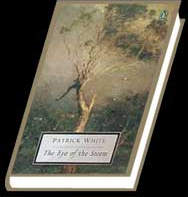
I feel sufficiently inspired by this to join in her Take Back the White movement and start a Patrick White Corner here, a small regular space for the old curmudgeon's own unique voice. Here, then, is the reading for today, from the source of the original hoax, The Eye of the Storm. I don't quite know why I remember this bit so clearly, but my guess is that most women, at least -- and I mean women of any age, in any time -- will shiver at it just a little.
'After receiving her mother's cheque Dorothy had considered splurging some of it on an important dress: an armature to intimidate any possible adversary, and to warn off what could be worse, an importunate admirer. But on sending for a statement almost immediately after paying the money into the bank, she thought she could not bring herself to reduce such a lovely round sum; she would make do with her trusty Patou black, enlivened with a jewel or two ...
On the night, then, it was the Patou black, of such an urbane simplicity it had often ended by scaring the scornful into a bewildered reassessment of their own canons of taste. And the diamonds; everyone must bow to those: their fire too unequivocally real, their setting a collusion between class and aesthetics. These were some of the jewels the colonial girl had been clever enough to prise out of her husband's family by knowing too much. If they had been more than a paltry fraction of the realisable de Lascabanes assets, and if she had not detested all forms of thuggery, Dorothy Hunter might have seen herself as a kind of female Ned Kelly.
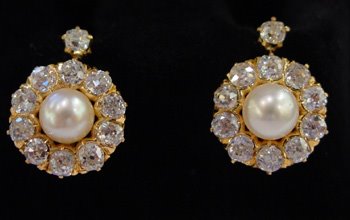
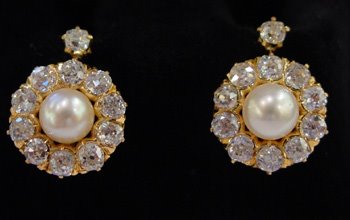
She was standing at the dressing-table mirror massaging the lobes of her ears before loading them with moody de Lascanbanes pearls encrusted with minor de Lascabanes diamonds. The earrings made her suffer regularly, but it was all in the game ...'
I feel sufficiently inspired by this to join in her Take Back the White movement and start a Patrick White Corner here, a small regular space for the old curmudgeon's own unique voice. Here, then, is the reading for today, from the source of the original hoax, The Eye of the Storm. I don't quite know why I remember this bit so clearly, but my guess is that most women, at least -- and I mean women of any age, in any time -- will shiver at it just a little.
'After receiving her mother's cheque Dorothy had considered splurging some of it on an important dress: an armature to intimidate any possible adversary, and to warn off what could be worse, an importunate admirer. But on sending for a statement almost immediately after paying the money into the bank, she thought she could not bring herself to reduce such a lovely round sum; she would make do with her trusty Patou black, enlivened with a jewel or two ...
On the night, then, it was the Patou black, of such an urbane simplicity it had often ended by scaring the scornful into a bewildered reassessment of their own canons of taste. And the diamonds; everyone must bow to those: their fire too unequivocally real, their setting a collusion between class and aesthetics. These were some of the jewels the colonial girl had been clever enough to prise out of her husband's family by knowing too much. If they had been more than a paltry fraction of the realisable de Lascabanes assets, and if she had not detested all forms of thuggery, Dorothy Hunter might have seen herself as a kind of female Ned Kelly.
She was standing at the dressing-table mirror massaging the lobes of her ears before loading them with moody de Lascanbanes pearls encrusted with minor de Lascabanes diamonds. The earrings made her suffer regularly, but it was all in the game ...'
Saturday, July 15, 2006
CHAPTER THREE ... in which St Patrick buys the How-To book
Where to begin an analysis, a commentary, or even just an incredulous expostulation in response to this?
For those who haven't already read the original paper article or the cut-down online version, here's the cartoon version: in imitation of a similar British hoax involving V.S. Naipaul, someone from The Australian -- possibly Jennifer Sexton, author of the article, who does not say who set this sting up -- sent Chapter 3 of Patrick White's The Eye of the Storm to twelve Australian publishers and agents, changing the names of the characters, re-titling the novel The Eye of the Cyclone (oh, dear; surely they could have been a bit witty about it, at least) and submitting the MS under a name manifestly not a real one, but an anagram of PATRICK WHITE.
('Wraith Picket', forsooth; why didn't they just call him Keith Crapwit and be done with it?)
Two publishers/agents have not yet replied, after three months, and the other ten all turned it down. Some suggested that St Patrick should read David Lodge's How-To book, and others that he should join a writers' centre. (He would have abominated how-to books and writers' centres.)
The chapter in question was one of the least typical bits, and I'm sorry to say probably one of the least successful bits, of White's writing that I can think of, short of his first two novels Happy Valley and The Living and the Dead, in which he was merely clearing his throat.
The offending chapter is smack in the middle of the action, jumps around chronologically, and, most atypically for White, is pretty much all narrated in free indirect discourse, reflecting the thought processes of the deeply awful character and the kind of language he would use.
I can't work out which is the worst:
(a) the bad faith of the entrapment, the smugness of its aftermath, and the shabby (and incoherent, as Jeff Sparrow points out in this excellent piece) reactionary agenda behind the exercise,
(b) the failure of the agents and publishers' readers who rejected the chapter to recognise either the actual novel or, at the very least, White's unique, highly spottable style, and the incontrovertible evidence it provides that people getting jobs in Australian publishing houses have clearly not seen fit to make it their business to read a little Australian writing, or
(c) the unambiguously, unashamedly and exclusively commercial agenda behind some of the rejections.
I could just cry. And I would, if this episode were not, in its own toxic way, so funny. Not one person or organisation comes out of this particularly well, except perhaps Michael Heyward from Text (no surprises there; Heyward has been one of the class acts of Australian publishing for twenty years), who expressed concern that it had happened and the opinion that publishers needed to be kept on their toes -- unlike everyone else quoted, who toughed it out so brazenly they would have made Pats and Eddie proud.
And maybe Patrick White himself, of course. And he, poor old poppet, is past caring. Or so one hopes.
UPDATE: More at Larvatus Prodeo.
Saturday, July 8, 2006
In memory of Lisa Bellear, 'not one for the easy road'
Aboriginal poet, photographer, activist, scholar and all-round comedian Lisa Bellear died in her sleep at home last week, of as-yet-unknown causes.
Lisa was a Goernpil/Noonuccal woman from Stradbroke Island in Queensland, living and working in Melbourne. She was 45.
She was one of the funniest people I've ever met. She was a wonderful advocate for Aboriginal causes. She was outspoken, energetic, brave, and a joy to be around.
Here's a poem of Lisa's that I've borrowed from scepticlawyer's blog.
Hanover Street Brunswick 3056
(On a bright sunny afternoon)
Cruisin' - on my way with a keen
sense of purpose: milk (full cream),
toasting bread, cigarettes, papers
...a woman's day
Sensor rays connect with a thirty
centimetre 'white' child who sits
joyously on a three-wheeled
plastic bike
I feel safe enough to share
my smile
As we check each other over
with carefree knowing smiles -
his parents raise their heads
through the pruned rose bush
In twenty years time will
he remember this warrior woman?
I wonder
For more on Lisa, in an Age article from two years ago, go here.

Thursday, July 6, 2006
John Kinsella and the Parliament of the Birds
I've just sent off a review piece on John Kinsella's last two books, The New Arcadia and America, to the Australian. Still thinking hard about the first one, which is an elaborate, focused, politicised portrait of Kinsella's home landscapes in the WA wheat belt.
One thing that struck and kept striking me about this book-length and formally elaborate, playful, engaged and enraged poem is the way it speaks to Les Murray's work without any sense of competitiveness, imitation or regrettable boyo muscling-up. I have no idea what relations are like between Kinsella and Murray but despite their political differences (not as huge, if their work is anything to go by, as some imagine, and certainly neither of them toes anybody else's party line) I bet they understand each other's work very well.
The New Arcadia is divided into five 'acts' each of which begins with a 'drive'. It's the same drive five times, at different times on different days in different moods: a meditation on being in and moving through a landscape. One of my favourite things about it is the birds. Kensella is armpit-deep in eco-politics and that's one of the bases of his vision here.
Where I'm living, in an old suburb of Adelaide that's fairly near the sea, one of the joys of the last eight and a half years has been the daily communing with assorted birds: blackbirds, rainbow lorikeets, musk lorikeets, sparrows, honey-eaters, pigeons, willy wagtails, magpies and crows are birds I see at least one of every day. Sometimes I wake to the crooning and burbling of next door's chooks; some days I see a seagull; and occasionally, bizarrely, I happen to look up and see a pelican ponderously riding some sky current or other, like an angel in a painting. But Kinsella's avian landscape puts this modest suburban flock to shame, and I like this poem and its ideological underpinnings so much, here's a tribute to him and his birds: a list of every feathered creature in the poem, and some of their best moments.
MAGPIE
KOOKABURRA
GALAH
CROW
EMU
CORELLA
FINCH
BLACK-FACED CUCKOO-SHRIKE
WAGTAIL
*****
In the corner paddock, four species of birds
congregate -- if not interacting
then scanning spaces between others'
courses: insect-hunting heron
knifing random lines between scattered
pink and grey galahs, magpie larks
stressing laws of genre, place, and limits,
and the crow watching acutely:
*****
RED-CAPPED ROBIN
LITTLE CORELLA
*****
... there was a species
of bird high in the salmon gum
that no longer exists,
*****
MULGA PARROT
TWENTY-EIGHT PARROT
WHITE COCKATOO
WHITE-FACED HERON
RUFOUS SONGLARK
SILVER-EYE
SWALLOW
EAGLE
BOOBOOK OWL
CHICKEN
ELEGANT PARROT
SKYLARK
CRESTED BELLBIRD
THORNBILL
HAWK
PURPLE-CROWNED LORIKEET
OWL
TAWNY FROGMOUTH
WHITE-TAILED BLACK COCKATOO
BLACK-SHOULDERED KITE
WEDGE-TAILED EAGLE
COCKATIEL
TURKEY
NIGHTJAR
*****
Three white-faced herons arrive this morning,
the extinct volcano weathered down to the emollient
of mist and oil of eucalypt, spiralling
on to the limbs of their roosting tree, body fed
on soakage and samphire, their deep-throated croak
the result of scandal or espionage, swaying
as the dregs of the front stir the mist and gently
whip the leaves, but never at risk
of unseating.
*****
YELLOW ROBIN
WOOD SWALLOW
GOLDEN WHISTLER
*******************
But now I will you tell a wondrous thing:
As long as I lay in that swooning,
Me thought I wist what the birds meant,
And what they said, and what was their intent
And of their speech I hadde good knowing.
Subscribe to:
Posts (Atom)